Why Handmade Art Matters More Than Ever in the Age of AI
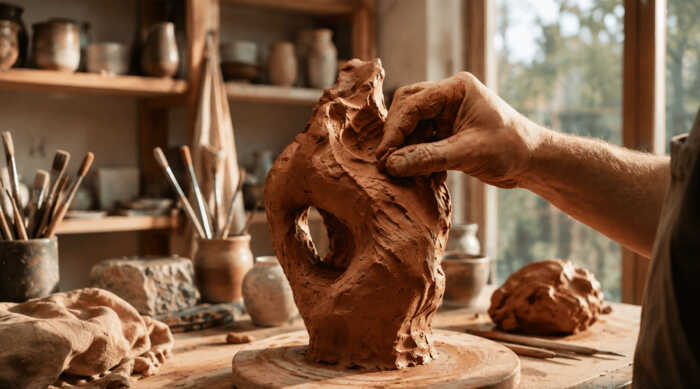
There is something easy to recognize about an object made by hand.
It might be a slight unevenness in a ceramic surface, a stitch that sits differently from the others, or a brush mark visible beneath layers of paint. These details are not necessarily mistakes. Often, they are simply evidence that someone was there, making decisions as the work took shape.
That kind of evidence feels more noticeable now, when images can be produced almost instantly.
AI tools can generate an illustration from a short description, offer multiple compositions in seconds, and make changes without starting again. Digital tools have opened possibilities that would have been difficult to imagine a generation ago.
Handmade work moves at another pace. A ceramic bowl has to be shaped, dried and fired. A painting may change through several layers. An embroidered textile can demand hours of concentration for a pattern that takes only a moment to understand when it is finished.
The difference is not only speed. It is what remains visible after the making is over.
The Marks That Tell Us How Something Was Made
Materials remember.
Clay records pressure from the hands. Wood keeps traces of tools. Fabric can reveal the tension of a stitch or a small change in a pattern. Paint can preserve the movement of a brush.
In person, these details can change the way we look at an object. A surface becomes something to examine rather than simply recognize.
That is one of the quiet strengths of handmade art: the finished object can contain evidence of the process that produced it.
Digital work has its own evidence, of course. Layers, edits and iterations are part of many artists' practices. Working on a screen makes it possible to test ideas, undo decisions and explore alternatives with remarkable freedom. Much of that process, however, remains hidden from the viewer.
A handmade object often leaves more of its history on the surface.
When the Process Becomes Part of the Work
There was a time when the question of how an image was made seemed relatively straightforward. A painting had a painter. A photograph had a photographer. A piece of furniture had a maker or workshop behind it.
Today, the path can be harder to trace.
An image may be photographed, edited, composited, generated with AI or produced through several of these methods at once. The growing variety of tools has made people more curious about what sits behind a finished image.
Who made the decisions? Which parts were automated? Where did the artist intervene?
Handmade work does not answer all of those questions, but it often gives us somewhere to begin. A fingerprint in clay or a slightly uneven line creates a small connection between the finished object and the person who made it.
That connection can feel meaningful because it has not been polished away.
The Value of Imperfection
We are used to surfaces that can be corrected almost indefinitely. A photograph can be retouched. A digital illustration can be adjusted pixel by pixel. A design can be revised until every element sits exactly where it should.
Handmade objects have different limits.
A pot may lean slightly. A wooden table may retain a mark from the tools used to make it. A woven piece may contain variations that could not be reproduced exactly, even if the maker tried.
Those differences can give an object its character.
This does not mean every irregularity is beautiful. It means that visible signs of making can make an object feel specific rather than interchangeable. A small variation can become something you recognize.
Over time, that can matter more than flawless symmetry.
Handmade and Technology Were Never Really Opposites
It is tempting to place handmade art on one side and technology on the other, especially when discussing AI. The history of art is not quite that simple.
Artists have always adopted new tools. A painter can sketch digitally before moving to canvas. A ceramic artist can use 3D modeling to develop a form. A textile designer can create a pattern on a computer before translating it into thread.
AI can enter that process too. An artist might use it to generate unexpected combinations, explore a visual direction or challenge an initial idea.
The important part is what the artist does with those possibilities. Someone still has to decide what is interesting, what should be discarded and what deserves to become a finished work.
Philadelphia and an Older Conversation About Making
The questions surrounding handmade work are not entirely new.
Philadelphia offers a useful example. In the late nineteenth and early twentieth centuries, industrialization was changing the way everyday objects were produced. Factories made goods faster and in greater quantities, while artists, designers and craftspeople questioned what might be lost as making became increasingly industrial.
Philadelphia developed its own response, with artists and makers working across ceramics, furniture, textiles, metalwork and stained glass. The Philadelphia Museum of Art's 2026 exhibition Workshop of the World: Arts and Crafts in Philadelphia explores that history and the relationship between craft, design and industry.
What makes the history relevant now is that the debate was never simply about rejecting technology. Philadelphia's Arts and Crafts makers were responding to industrialization while engaging with new forms of production and design.
The question was closer to this: what should remain important when the way we make things changes?
AI has introduced a different kind of acceleration, but the concern is familiar. When production becomes faster and easier, which parts of the making process do we still value?
When Taking Longer Is Part of the Point
One of the things handmade work asks from us is time.
A craftsperson can spend years learning how a material behaves. A woodworker repeats movements until they become instinctive. A textile artist may spend hundreds of hours on a single piece.
Most of that effort disappears once the object is finished. We see the chair, not the hours spent shaping it. We see the embroidered pattern, not the evenings spent making each stitch. We see the ceramic vessel, not the failed versions that came before it.
This may be part of the appeal of practices such as film photography, ceramics, knitting and woodworking. Sometimes the process itself is the reason to do something.
Making by hand requires attention in a way that scrolling through finished images does not. There is room for repetition, mistakes and small adjustments. The result matters, but so does the time spent getting there.
Why Physical Objects Still Feel Different
Most of us encounter far more images of art than art itself.
We can scroll through museum collections, discover artists online and see detailed photographs of objects without ever standing in the same room with them. That access is valuable, but a photograph still leaves something out.
A sculpture has weight. A textile changes when light moves across it. A painting has a scale and surface that can be difficult to understand from a screen.
The same is true of ordinary handmade objects.
A handmade mug is more than its shape in a photograph. You notice its weight, where the glaze changes, or the small irregularity along the rim. A wooden chair gathers marks as it is used. A knitted garment can become associated with the person who made it.
These objects gradually become part of everyday life.
Why Handmade Art Still Matters
Handmade art does not need to compete with AI on speed, volume or technical precision.
Its appeal lies elsewhere: in the material, the time, the decisions and the traces left after the work is finished.
That does not make handmade art more authentic by definition, nor does it make digital art less meaningful. Artists have always worked with the tools available to them. What changes is the kind of attention those tools ask from us.
In a culture filled with images that can be produced, edited and replaced almost instantly, a physical object can encourage a different kind of looking.
You can pick it up. You can see where the surface changes. You can notice something that was never meant to be perfectly uniform.
Perhaps that is why handmade work feels relevant now. Not because it belongs to a world without technology, but because it reminds us that making can still take time, leave traces and result in something that exists beyond the screen.