The Return of the Tactile: Why Contemporary Art Wants Us to Touch Again
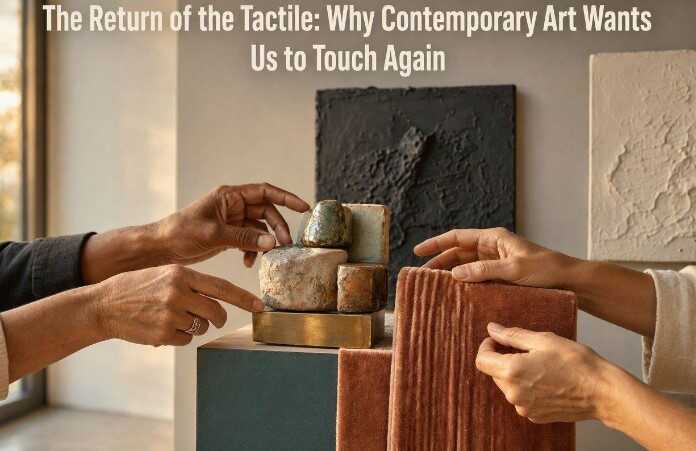
There is a difference between seeing an artwork and being in the same room with it.
A photograph can show a sculpture from the best possible angle. A video can take us through an installation. Yet neither quite explains what happens when an artwork occupies physical space alongside us.
Its scale becomes harder to ignore. We notice how far we have to walk around it. We become aware of our own position in relation to it. Sometimes we even imagine how a surface might feel without ever touching it.
This kind of encounter is becoming increasingly relevant to contemporary art. Not because artists are turning away from digital culture, but because the physical artwork offers a different pace and a different kind of attention.
The point is not literal touch. Museum visitors are rarely allowed to touch the work. The tactile is broader: an awareness that an artwork has weight, volume, resistance and a relationship to the person looking at it.
The Image Has Changed the Way We Look
Art has never been experienced only in galleries, but the balance has shifted.
A painting can now be seen many times before we encounter the original. Social media, reviews and exhibition videos can give us a strong sense of a work before we enter the gallery. That makes the difference between documentation and presence more noticeable.
An image gives us information quickly. A physical encounter takes longer.
Scale is one obvious example. A work that appears modest on a screen may dominate a room. An installation may require us to move through it rather than simply look at it. Even a small object can change when viewed from different distances.
Contemporary artists increasingly use this relationship between viewer and work as part of the artwork itself. We are not simply looking at an object; our position, distance and movement become part of how it is experienced.
From Surface to Space
This is where the current interest in textile and craft-based practices becomes more interesting than a simple revival of handmade aesthetics.
At the Whitworth in Manchester, Hyundai Translocal Series: Entangled and Woven, on view from July 10, 2026 to January 3, 2027, brings new work by artists and collectives from India and Korea into conversation with historic textiles from the museum's collection. The exhibition addresses migration, labour, cultural exchange and shared making, but its ideas are also experienced spatially. Jounghye Yoo's Gilded Veil, for example, creates a passage of layered fabric that visitors move through rather than view from a fixed position. The work draws on Indian and Korean textile traditions, including ajrakh printing and embroidery.
The textile is not simply there to be examined. It changes how the viewer moves through the room.
A different example is Igshaan Adams's Between Then and Now, presented at Mudam Luxembourg in 2026. Adams works across textiles, sculpture and performance, using materials including beads, chains, rope, ribbons and woven elements. The exhibition brings together works connected to personal memory, spirituality, movement and shared histories. Its installations are not simply surfaces to inspect; they create relationships between fragments, bodies and space.
In both cases, material is doing more than providing texture. It helps organize space and direct attention.
The Body Becomes Part of the Viewing Experience
When we stand in front of a large work, we measure it almost instinctively against ourselves. We step back. We lean in. We walk around. Our bodies become a quiet measuring device.
What feels different now is how valuable that physical interruption can become after so much visual experience happens at a fixed screen distance.
A screen gives us an image from a predetermined viewpoint, while a gallery leaves more of the encounter to us.
Instead of receiving an image immediately, we negotiate with an object or environment. We decide where to stand, notice other visitors and become aware of light changing across a surface.
This is not necessarily slower in every case. Some installations are overwhelming or deliberately disorienting. What matters is that the viewer has to respond to the space around the work.
Why Materials Matter Without Being the Subject
The renewed attention to textiles, ceramics and other material practices is sometimes described as a return to craft. That description is useful, but incomplete.
A material can carry cultural memory without the artwork being “about craft.” It can record labour without turning labour into a spectacle. It can make an abstract idea feel bodily rather than simply intellectual.
The Saint Louis Art Museum's Aymara Weavings: The Indigenous Andes, on view through September 13, 2026, presents Aymara textiles made primarily from hand-spun and hand-dyed camelid fibers, showing how artists in Bolivia maintained and reinvented weaving practices to express Indigenous identities during the colonial period.
Here, the physical qualities of the textiles are inseparable from their history. The material is not an added sensory feature. It is part of what the objects are saying.
That is an important distinction for contemporary art. Tactility does not have to mean making an artwork pleasant to touch or visually rich in texture. It can mean allowing material, process and physical presence to carry knowledge.
The Pleasure of Resistance
There is something refreshing about materials that do not behave like images.
Fabric folds. Clay keeps traces of pressure. Wood has a direction. Metal has weight. Paper can crease or tear.
These qualities introduce resistance. They remind us that the object was made, moved, assembled, stretched, fired, stitched, cut or installed under particular conditions.
An artwork can therefore feel different in person even when we already know what it looks like. The surprise may be in physical evidence that the image could not fully communicate.
Digital and Physical Are Already Entangled
It would be misleading to describe the return of the tactile as a rejection of technology.
Contemporary artists are using digital fabrication, projection, scanning, video and computational processes alongside weaving, ceramics and other hands-on techniques. The interesting work often happens in the overlap.
The 2026 exhibition Video Craft at San Francisco's Museum of Craft and Design brought video into dialogue with ceramics, textiles and glass. Running from February 28 to August 16, 2026, it brought together nearly 20 artists and examined shared ideas such as encoding, looping and sampling. One example, Gregory Climer's The Animated Quilt of Nathan and Bryan, used 36 quilts to create a stop-motion animation, turning months of textile labour into a brief digital loop.
The example complicates the usual digital-versus-handmade argument. The digital image does not erase the physical work; it depends on it.
A digitally designed pattern may become a woven object. A scanned surface may be translated into sculpture. A traditional technique may be modified through digital tools.
The question is what each medium makes possible.
What the Tactile Gives Back
Perhaps the strongest argument for physical art is also the least dramatic: it gives us another way to look.
A physical artwork cannot be enlarged with two fingers. It cannot be swiped away. It has a fixed location, even when our understanding of it changes as we move.
That limitation can be useful.
It asks us to stay with one thing for a little longer. Not always because the work is quiet or meditative, but because its meaning may unfold through proximity, scale, movement and details that only appear when we are actually there.
This does not make the gallery experience more authentic than looking at art online. Screens have opened art to people who might never have access to certain museums or exhibitions. Digital documentation can preserve performances, make archives searchable and allow works to travel far beyond their original location.
But documentation and encounter are different experiences.
Perhaps that is why the tactile feels relevant now. It is not a return to some pre-digital idea of art. It is a reminder that an artwork can ask something of our bodies as well as our eyes.
Once we notice that, the gallery can feel slightly different. We start paying attention not only to the work, but also to where we are standing, how close we are, what blocks our view, and what becomes visible when we shift position.
The artwork is still the same object. The encounter with it is not.