The Art of the Ordinary: Why Contemporary Artists Are Looking at Everyday Life Again
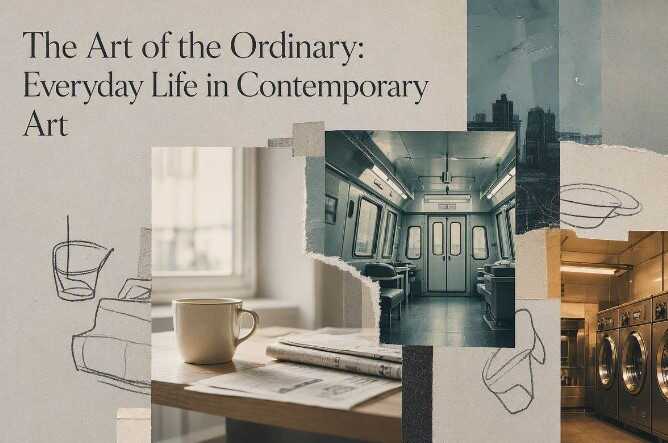
A shopping bag by the door. A photograph saved on a phone. A sofa marked by years of use. A familiar route through the city.
Most of the time, these things barely register. They belong to the background of daily life, noticed mainly when something changes.
Contemporary artists have good reason to look there. The routines and objects around us can reveal how people work, remember, consume, care for one another and organise their time. They can also bring less visible parts of life into view: domestic labour, family histories, economic pressures and the images that shape what people expect from themselves.
In 2026, several exhibitions are making this territory particularly visible. Rather than turning the familiar into something spectacular, they examine what can be learned from the things and actions that usually pass without much attention.
From Extraordinary Subjects to Ordinary Evidence
The use of familiar subjects in art is hardly new. The readymade, Pop art and conceptual practices all challenged the assumption that an artwork needed an exceptional subject or precious material.
The contemporary question is slightly different.
Artists are often less interested in presenting a single household object as art than in examining the experiences and systems around it. A family photograph can become evidence of a relationship. An advertisement can reveal changing ideas about beauty. A household tool can point towards invisible labour. A discarded package can say something about consumption.
The visual environment has changed, too. People photograph meals, rooms, purchases and journeys almost automatically. Daily experience produces an enormous archive of images, but having more images does not necessarily mean paying closer attention to them.
Artists working with familiar subjects can interrupt that process. They can take an image, object or action that would normally disappear into the background and give it enough space to be examined.
The Domestic World as Personal History
The home offers a particularly revealing record because it contains private histories.
A photograph on a wall, an old piece of furniture, a child's drawing or an object kept after someone has died may carry associations that have little to do with its monetary value. These things can locate a person within a family, a period of time or a particular set of relationships.
Contemporary artists can use such material without turning the work into straightforward autobiography.
France-Lise McGurn's The Charm Offensive at Dundee Contemporary Arts is a useful example. Opening on 22 August 2026, the exhibition brings together paintings with drawing, furniture, objects and ephemera from the artist's studio. DCA describes the exhibition as a significant development in McGurn's practice and a return to Dundee, where she studied.
The exhibition also brings personal and cultural source material into the gallery. McGurn has worked with family photographs, film imagery and magazine advertisements, while the exhibition includes a paint-covered sofa from her studio. This places some of the circumstances behind the paintings alongside the finished works.
The sofa matters because it belongs to the artist's working environment rather than the conventional language of exhibition display. It gives visitors a glimpse of the place where the work was made and complicates the boundary between studio life and gallery presentation.
When a Simple Action Becomes a Work
Other artists approach daily experience through actions rather than objects.
Maren Hassinger's practice has long involved movement, performance and materials used in ways that draw attention to relationships between people, objects and the natural world. Her 2026 retrospective Living Moving Growing at the Berkeley Art Museum and Pacific Film Archive surveys work from the early 1970s to the present across sculpture, performance, video and installation. It runs through 29 November 2026.
The exhibition includes early work as well as later projects, making it possible to see how Hassinger's interests have developed over decades. BAMPFA is also presenting participatory elements connected to the retrospective, including Wrenching News, a collaborative work made by twisting and knotting newspapers, and a new presentation of Monument (Pyramid) created with redwood sticks from the UC Botanical Garden.
These examples are useful because they shift attention away from the finished object alone. A repeated action, a collaborative process or a material gathered from a particular place can become part of the artwork's meaning.
The viewer is not simply looking at a thing. They are being asked to consider how it was made, handled or experienced.
Family Images, Screens and the New Archive
Photography has made personal experience easier to collect than ever.
People now carry thousands of images on their phones, many documenting moments that might once have remained private or been forgotten. Family photographs, screenshots, advertisements and fragments of online culture can sit together in the same archive.
Artists can work with this mixture without treating every image as a conventional photograph.
McGurn's The Charm Offensive again offers a useful case. The exhibition brings source material such as film imagery, magazine advertisements and family photographs into conversation with her paintings.
This reflects a broader change in how personal archives are formed. A photograph no longer has to be printed, framed or placed in an album to become part of someone's history. It may remain on a phone for years, surrounded by hundreds of unrelated images.
For artists, that creates a different kind of archive: less orderly, more immediate and often harder to separate from popular culture.
What Familiar Things Reveal About Work
Daily routines can also make forms of labour visible that are usually taken for granted.
Cooking, cleaning, caring for children, commuting and administrative work occupy a large part of people's lives, yet they rarely receive the same cultural attention as more visible forms of professional or creative activity.
Contemporary artists can address this imbalance without illustrating labour directly. Objects, photographs, documentation and repeated actions can show what kinds of work are required to keep a household, studio or community functioning.
There is an economic dimension as well. The objects people repair, replace, save or throw away are influenced by what they can afford. A worn piece of furniture can indicate longevity or financial constraint; a collection of packaging can point towards consumption and waste.
These details can turn an apparently neutral object into evidence of a much larger system.
Why This Matters in 2026
There is a particular tension between contemporary art and the current image economy. People are surrounded by highly edited photographs, short videos and carefully constructed versions of personal life. At the same time, museums and galleries continue to ask audiences to spend time with objects and images in physical spaces.
The two worlds are not completely separate. Artists move between them.
McGurn's use of film stills, advertising and family photographs reflects a culture in which personal memories and commercial imagery increasingly share the same visual space. Hassinger's retrospective offers a different response, bringing movement, participation and long-term artistic development into a museum setting.
Together, these practices suggest that the question is no longer whether an artist can make work from familiar material. That possibility has been established for decades. The more interesting question is what kind of attention an artist can create around it.
In an environment built around constant visual turnover, choosing to stay with one image, action or object can itself become a meaningful artistic decision.
Looking at What Is Already There
Art about daily life does not need to claim that familiar things are secretly extraordinary.
Its strength can be more practical. It gives viewers a reason to notice how objects acquire histories, how images circulate between private and public life, and how repeated actions shape the experience of a day.
A family photograph may reveal as much through the fact that someone kept it as through the people pictured in it. A studio sofa can show something about the conditions behind an artist's work. A collaborative action can make visible relationships that would be difficult to communicate through a finished object alone.
That kind of attention feels useful in 2026. There is no shortage of images competing for a viewer's time, but there is still value in spending a little longer with one.
For contemporary artists, the material is already there: in homes, phones, studios, streets and routines. The challenge is deciding what deserves to be looked at again.