The Quiet Power of Texture in Contemporary Art
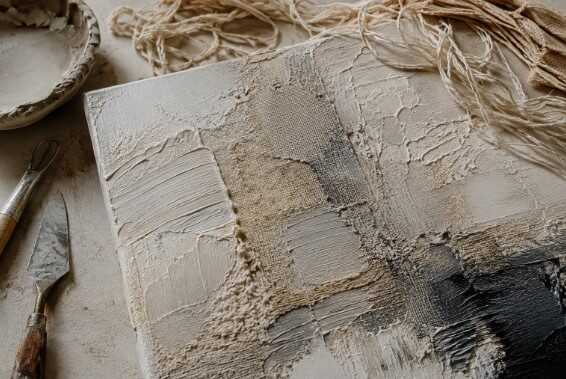
Some artworks resolve instantly from across a gallery room, delivering their full visual thesis at a distance. Others operate with a subtler force—compelling us to step closer and examine the physical landscape of the surface. A thick line of impasto catches the light; a rough, unprimed patch of canvas sits beside an area of pristine smoothness; loose threads cascade beyond the frame; and wet clay bears the delicate imprint of a sculpting tool. None of these details is necessarily the primary subject, yet together they can fundamentally alter how we experience and remember an artwork.
Texture possesses a unique capacity to bridge the gap between sight and touch. Although we traditionally classify visual art as an optical medium, a surface that appears soft, rough, heavy, cracked, or unpredictable inevitably engages our memory of touch. We do not merely look at such a surface; we mentally project what it would feel like beneath a fingertip. In these moments, the eye seems to involve the hand, creating an internal connection between seeing and imagining touch.
This interplay has become increasingly important in contemporary practice, where materials are no longer treated simply as neutral carriers for an image, but as expressive elements that carry meaning of their own.
When the Surface Starts to Speak
Because visual art is so heavily mediated by color, scale, and iconography, texture is often the last element a viewer consciously registers. A large-scale canvas might first establish its presence through bold color relationships or geometric composition. Only after we linger does its physical nature emerge: dense layers of pigment, directional brushwork, scraped gouges, exposed weave, and shifts between matte and high-gloss finishes.
Every medium brings a distinct physical vocabulary. Oil paint sits heavily upon linen, retaining the energy of its application long after drying. Graphite leaves a silvery sheen that responds to shifting light, while paper can be folded, torn, layered, or soaked to alter its structure. Wax, fabric, timber, cast metal, and clay each possess their own tendencies. Contemporary artists work with these behaviors rather than simply forcing them into submission.
This is where materiality becomes more than a technical concern. A jagged surface can disrupt an otherwise harmonious composition, while a repeated tool mark can suggest the passage of time. Heavily built-up pigment gives a two-dimensional image a tangible sense of weight. When raw canvas is exposed, the history of the work’s creation becomes visible. A complex surface can therefore slow down the act of viewing, holding our attention in an age of rapid visual consumption.
Why We Look Closer
Texture changes the physical distance between an artwork and its audience. Viewed from across a room, a painting might project the illusion of absolute flatness. Yet, as we approach, another version of the work emerges. Shadows cast by raised ridges of paint become visible, minute scratches assume significance, and small irregularities begin to command our attention.
This transformation is particularly pronounced in non-representational and abstract art, where recognizable imagery is intentionally absent. Without a figure, portrait, or landscape to guide interpretation, the viewer’s attention gravitates toward weight, density, repetition, surface tension, and gesture. A deeply scraped section of pigment can suggest removal or loss. Heavy applications of paint give the work a sculpted presence, while a grid of minute incisions creates an almost architectural rhythm.
Recent research has shed new light on this connection between visual input and physical sensation. A 2026 study published in Scientific Reports examined how tactile exploration of visually similar artworks with matching or mismatching tactile properties influenced aesthetic evaluation. The researchers found that artworks whose visual and tactile qualities were congruent received higher ratings for beauty, pleasure, and interest. Stronger neural responses associated with sensory surprise were also linked to higher beauty ratings under certain conditions, suggesting a more complicated relationship between expectation, harmony, and surprise. What we imagine a surface feels like can therefore become part of the visual experience itself.
Materials Bring Their Own Character
Artists never begin their work with entirely neutral materials. Every substance arrives with its own structural history, mechanical tension, and cultural associations. Wood has grain, knots, and internal stresses that affect how it can be carved or bent. Clay is fluid and vulnerable before firing, yet becomes extremely rigid afterward. Fabric drapes and responds to gravity, while metal offers a resistance that contrasts with the delicacy of paper. Even oil paint varies in viscosity, elasticity, and drying time.
A compelling example of this material dialogue appeared earlier in 2026 at Philadelphia’s Wexler Gallery. From January 22 through March 6, the gallery presented Material Voices, a three-person exhibition featuring Jennifer Trask, Sofia Karakatsanis, and Erin Sullivan. The exhibition brought together three practices around material memory, transformation, and the relationship between nature and human intervention. Karakatsanis, in particular, approaches wood as a responsive material, allowing its grain, tension, and movement to guide the evolving form.
When artists allow these physical traits to remain visible, the material becomes part of the creative decision-making process rather than simply a container for it.
Texture Is Not Just a Painting Problem
Some of the most adventurous tactile experimentation in contemporary art unfolds beyond the traditional stretched canvas. Fiber arts and textiles offer a particularly rich field of inquiry. For generations, weaving, embroidery, and tapestry were often marginalized within art history and categorized under functional craft. Today, contemporary artists regularly use these techniques to challenge the boundaries between decorative craft and fine art.
This shift is reflected in current programming at The Fabric Workshop and Museum in Philadelphia, which is presenting You Stretched Diagonally Across It: Contemporary Tapestry from July 16, 2026, to January 3, 2027. The exhibition explores how contemporary artists challenge the material, ideological, and narrative conventions of tapestry, while testing the boundaries between art and craft, perception and tactility, tradition and improvisation.
Ceramics offer another arena for tactile exploration. Clay can be burnished to a glassy sheen or left raw, porous, and visibly scarred by fire and tools. A vessel might retain fingerprints, structural cracks, or uneven seams, offering the viewer a record of its making. We respond not only to the final form, but to the visible passage of time and physical labor encoded in the clay.
The Marks That Give a Work Away
A sudden hesitation in a brushstroke, an unexpected shift in thread tension, a patch of paint sanded back to reveal hidden layers, or an unhemmed fabric edge left to fray naturally—these irregularities can become physical records of human agency. They mark specific choices, pauses, and the passage of time within the studio.
This does not mean that an artwork displaying visible marks of its creation is inherently more valuable than one with a pristine, highly controlled finish. Precision, smoothness, and the deliberate erasure of human handling can be equally powerful artistic strategies. Many contemporary artists deliberately eliminate every trace of the hand to achieve a cool, industrial, or digital anonymity.
When marks of process remain visible, however, they provide a trail that allows the viewer to mentally reconstruct the actions that brought the object into existence. This human imprint helps explain why audiences often form deep emotional connections to materials that bear visible signs of use, transformation, and physical history.
Texture Can Change the Mood of a Work
Long before a viewer engages with the conceptual premise of an artwork, its material surface quietly sets an emotional tone. Soft, yielding textiles can evoke intimacy, vulnerability, and domestic memory, whereas cold stone or raw steel may suggest austerity, permanence, or detachment. A high-gloss surface maintains an impersonal distance, while damaged or distressed texture can hint at decay, vulnerability, and history.
These associations are not fixed. Contemporary artists often subvert expectations to create tension within a work. A fragile material can become a monumental structure; a delicate surface can be covered with something abrasive and uncomfortable. In such cases, texture prevents the work from settling into simple decoration. The surface challenges the imagery and forces the viewer to reconsider their emotional response.
A Different Way of Experiencing Art
The modern museum experience is governed by an unavoidable paradox: visitors are instructed not to touch the objects on display. Because textiles, delicate glazes, aged paper, and unvarnished paint are susceptible to oil and wear from human hands, long-term preservation demands physical distance.
Yet this boundary creates a fascinating psychological effect. Deprived of actual physical contact, the viewer’s perception can amplify haptic imagination. We mentally feel the density of woven wool, the cool surface of a ceramic vessel, or the coarse grain of a wooden sculpture through visual cues alone. This imagined physical engagement can become part of the aesthetic experience, allowing us to touch the artwork in our minds even while our hands remain comfortably in our pockets.
Why Material Still Matters
In a digitally saturated culture, it can be tempting to reduce texture to a secondary detail—an aesthetic accent applied after decisions about subject matter, composition, and narrative have already been made. Contemporary practice continually challenges this assumption, demonstrating that material choice can shape the structure of a work, its conceptual content, and its relationship to cultural history.
This continuity is currently on display at the Philadelphia Museum of Art in Workshop of the World: Arts and Crafts in Philadelphia (July 12 to October 11, 2026). Featuring more than 250 objects, including ceramics, furniture, metalwork, textiles, and stained glass, the exhibition explores Philadelphia’s distinctive role in the Arts and Crafts movement and its continuing influence on contemporary makers.
Texture is rarely an accidental feature of the surface; often, it is the reason we stop and engage. We lean in to inspect a raised edge, a rough patch, a loose thread, a surface fracture, or the bite of a chisel because the object offers an experience that cannot be absorbed instantly or digitized without loss. That is the quiet, enduring power of texture in contemporary art: it gives the eye something physical to inhabit, reminding us that art remains, at its core, a deeply embodied human experience.