Philadelphia Beyond the Tourist Map: Places That Reveal the City’s Creative Spirit
Philadelphia is easy to recognize. The Liberty Bell, Independence Hall, the Benjamin Franklin Parkway and the steps of the Philadelphia Museum of Art appear in almost every first introduction to the city. They deserve their place, but they are not the whole picture.
Look a little closer and Philadelphia starts to feel less predictable. A former bank is now an immersive art environment. A prison survives as a place for thinking about architecture and justice. Mosaics spill from a museum into a neighborhood, while an old industrial landscape has been given a new life as public space.
For visitors interested in art and culture, these places offer a different way into the city. Some are major institutions. Others are harder to find. They also show how history and contemporary creativity can exist on the same streets.
Start with the familiar: Philadelphia Museum of Art
The Philadelphia Museum of Art is an obvious starting point, but 2026 gives visitors a particularly good reason to go beyond the famous staircase.
This year the museum is presenting A Nation of Artists, a major collaboration with the Pennsylvania Academy of the Fine Arts and the Middleton Family Collection. At the museum, the exhibition runs from April 12, 2026, through July 5, 2027, bringing together American art from 1700 to 1964 and examining the international connections, technological changes and shifting ideas that shaped it. The exhibition is part of Philadelphia’s wider program for the 250th anniversary of the United States.
The museum itself is also celebrating its 150th anniversary in 2026. That makes the building, its collection and the surrounding Benjamin Franklin Parkway worth considering together rather than treating the museum as a single stop on a sightseeing route.
See American art differently at PAFA
A short walk from the Parkway, the Pennsylvania Academy of the Fine Arts adds another layer to the story.
Founded in 1805, PAFA is the first museum and school of fine arts in the United States. Its Historic Landmark Building, designed by Frank Furness and George W. Hewitt, has long been part of Philadelphia’s architectural identity. In 2026, it has an especially strong contemporary-art connection through A Nation of Artists.
The PAFA presentation is organized thematically rather than simply chronologically and places 21st-century artists in dialogue with earlier American art. The exhibition runs through September 5, 2027. Instead of presenting contemporary art as a separate chapter, PAFA puts it into conversation with the histories that came before it.
For visitors, the two institutions offer different ways of looking at the same broad question: what does American art say about the country that produced it?
Step inside Ministry of Awe
One of Philadelphia’s newest cultural experiences is also one of its strangest.
Ministry of Awe occupies a converted 19th-century bank at 27 North 3rd Street in Old City. The 8,500-square-foot experience extends across six stories and combines large-scale installations, soundscapes, tunnels, labyrinthine corridors and interactive elements. Rather than moving from gallery to gallery, visitors move through an environment designed to be explored.
That makes it different from a conventional museum. Ministry of Awe is closer to an art environment than a traditional gallery, and the historic building is part of the experience rather than a neutral container for it. The project was developed by Philadelphia artist Meg Saligman with more than 100 artists and opened to the public on March 14, 2026.
It is also a distinctly 2026 addition to Philadelphia’s cultural landscape, arriving during a year when the city is adding new museums, galleries and cultural experiences alongside its 250th-anniversary programming.
Follow the mosaics at Philadelphia’s Magic Gardens
On South Street, Isaiah Zagar’s Philadelphia’s Magic Gardens offers a very different kind of art environment.
Zagar covered the site with mosaics made from ceramic tiles, mirrors, bottles, found objects and other materials, turning walls and architectural surfaces into a dense visual field. His work extends beyond the museum itself: more than 200 mosaic walls created by Zagar can be found around Philadelphia.
There is another site worth knowing about. The Magic Gardens Studio at 1002 Watkins Street occupies a former auto repair shop that Zagar transformed over more than 14 years. The 10,000-square-foot space is covered in mosaics and was opened to the public in 2024 through the nonprofit Philadelphia’s Magic Gardens.
The studio also gives a clearer sense of how Zagar worked with materials. You can see where objects were accumulated, where mosaics were made and how an art practice can gradually take over an entire building.
Look for art on the street
Philadelphia’s public art culture is impossible to separate from the city itself.
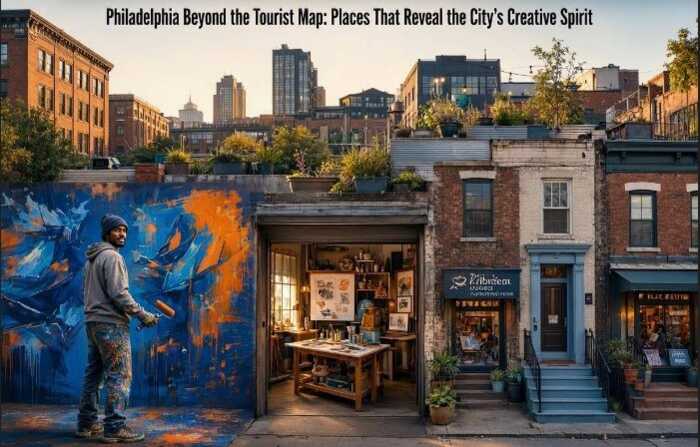
Mural Arts Philadelphia has produced more than 4,500 murals through collaborations between artists, communities and local partners. The program has been working across the city for more than four decades, making murals part of neighborhoods rather than something encountered only inside cultural institutions.
That history is continuing in 2026. Mural Arts is presenting a yearlong lineup connected with the city’s 250th-anniversary celebrations, including new murals and community projects.
There is also an interesting moment of transition. On September 1, 2026, Emily Mello is scheduled to become Mural Arts Philadelphia’s executive director, succeeding founder Jane Golden after more than four decades of leadership. Mello has said she wants public art to be recognized as essential to civic life.
For visitors, the point is simple: leave some room in the itinerary for looking up. In Philadelphia, the walls are often part of the cultural map.
Enter Eastern State Penitentiary
Eastern State Penitentiary is one of those places that changes depending on how you look at it.
Opened in 1829, the prison was designed by John Haviland around a radial plan, with cellblocks extending from a central hub. Its architecture was closely tied to the Pennsylvania System of solitary confinement, which was intended to encourage reflection and reform.
The prison closed in 1970. Rather than being completely restored, much of the site has been preserved as a stabilized ruin, leaving deterioration, exposed materials and layers of later construction visible.
The result is a building where age, neglect and changing ideas about preservation are still visible. You are not looking at a polished reconstruction of the past, but moving through a structure that has kept much of its physical history.
In 2026, Eastern State is also presenting A Time for Liberty: Our Shared History, Our Shared Future, a yearlong program exploring liberty, justice and the evolving American criminal justice system as part of the 250th anniversary.
Slow down at Shofuso
Shofuso Japanese Cultural Center offers a quieter change of pace in West Fairmount Park.
The house was designed by Japanese architect Junzo Yoshimura in 1953, built in Nagoya using traditional materials and techniques, and later moved to Philadelphia after its exhibition at the Museum of Modern Art in New York. It was reassembled at its current site in 1957–58, and the garden was redesigned by Japanese landscape designer Tansai Sano.
The interest here is not limited to the building. The house, garden, water, materials and views are meant to be experienced together. Shofuso is a useful reminder that design can be spatial and atmospheric rather than something contained within an object.
It also connects Philadelphia to a much longer history of Japanese cultural exchange. A Japanese garden had already been established on the site during the 1876 Centennial Exposition.
Walk through Bartram’s Garden
Bartram’s Garden is farther from the usual tourist routes, and that is part of its appeal.
The site is associated with botanist John Bartram, who established his farm and garden along the Schuylkill River in 1728. Today, the landscape includes historic buildings and gardens alongside trails, river access, community farming and natural areas.
The site has a layered history. It connects botanical collecting and early American science with later industrial development, neighborhood history, environmental restoration and contemporary community use.
It is also a useful counterpoint to Philadelphia’s museums. Here, the landscape itself becomes the cultural object, and the experience depends as much on walking and observing as it does on reading historical information.
Philadelphia rewards a slower itinerary
The interesting thing about these places is that they do not form a neat category. Some are museums, some are historic sites, some are working cultural organizations, and others are public spaces.
That is part of what makes them work together.
A visit to Philadelphia can start with the places everyone knows. But after that, it is worth leaving room for the spaces that are harder to summarize: an old bank filled with immersive installations, a mosaic-covered former garage, a prison preserved in partial ruin, a Japanese house in a city park, or a mural that turns an ordinary wall into part of the neighborhood’s visual history.
In a city marking 250 years of American history, there is plenty to look backward at. There is also a lot being made right now.
Sometimes the best way to see that side of Philadelphia is simply to leave some time for it.