The New Art of Waiting: Why Slowness Is Becoming a Contemporary Artistic Strategy
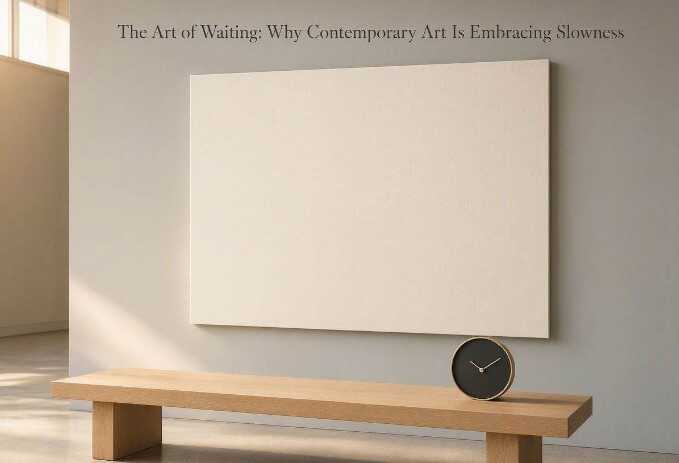
There are artworks that ask for attention, and then there are artworks that make attention part of the work.
A performance might continue long after its initial spectacle has faded. A video may seem almost uneventful until several minutes have passed. An installation can leave a visitor waiting for something to happen, only for the waiting itself to become part of the experience.
This is not simply a matter of looking more slowly. In some contemporary practices, time becomes one of the conditions through which an artwork exists. The viewer's arrival, patience, boredom or decision to leave can affect what the work becomes.
That approach feels particularly noticeable now, when so much visual culture is built around speed.
The Pressure to See Everything
A museum visit can easily become a form of visual accumulation. One room leads to another, then another. There are labels to read, works to recognize and exhibitions to finish before closing time.
The problem is not necessarily inattentiveness. There is simply a lot to process.
Some artists respond to this condition not by making their work more immediately compelling, but by refusing to provide everything at once. They stretch an action, repeat a gesture or withhold an expected resolution. The viewer has to spend time before knowing whether that time will be rewarded.
That uncertainty is part of the point.
When Nothing Seems to Happen
Waiting is an unusual artistic material because it can initially feel like an absence.
A conventional narrative gives us progression. A performance has a beginning and an end. A film moves from one scene to the next. Waiting interrupts that expectation. It creates a stretch of time in which the viewer is aware of duration without necessarily receiving new information.
That can be uncomfortable. It can also change what becomes visible.
A movement that seemed insignificant after thirty seconds may look different after five minutes. Repetition can begin to suggest labor rather than pattern. A performer who appears motionless can become increasingly difficult to separate from the architecture around them.
The viewer may start noticing the room itself: other people's movements, changes in light, the position of their own body, or the temptation to leave.
At that point, waiting is no longer outside the artwork.
Duration as a Material
Contemporary art has a long history of working with duration. Performance artists have used extended actions to test endurance, repetition and the relationship between performer and audience. Video artists have stretched ordinary moments beyond the amount of time viewers might normally give them.
The context has changed, however. A visitor now encounters an exhibition alongside a culture of constant visual switching.
An artwork that insists on duration creates a different boundary. It asks whether an experience can be compressed without changing it.
That does not mean every slow artwork is successful. Some are simply boring. Slowness is not automatically profound, and patience is not a substitute for an idea. The more useful question is what the artist is doing with the time they have taken from the viewer.
The Body Has to Keep Showing Up
Performance makes this especially visible because duration is registered by the body.
Florentina Holzinger's SEAWORLD VENICE, presented in the Austrian Pavilion at the 61st Venice Biennale, combines dance, theatre and performance in a permanent live installation. The project uses water as both subject and material, bringing bodies, technology and a changing environment into the same space. It runs from 9 May to 22 November 2026, with performances and site-specific Études forming part of the wider project.
The important point here is that visitors can encounter the installation at different moments. Someone arriving early will not necessarily experience the same sequence as someone entering later. The visitor's position within the unfolding event matters.
Repetition Can Make Time Visible
Waiting does not always mean complete stillness.
Repetition can produce a similar effect. When an action is repeated enough times, the viewer stops concentrating only on what is being done and starts becoming conscious of the time required to do it.
At first, repetition asks a simple question: what happens next?
Eventually another question appears: how long can this continue?
This is one reason repeated actions have remained important in performance and process-based practices. They expose effort. They can make routine visible. They can also resist the expectation that every artistic gesture should lead somewhere.
In a gallery, this is particularly noticeable. Visitors are accustomed to moving from one finished object to another. A repeated action has no such clean separation between making and viewing. The work keeps unfolding while the viewer decides whether to stay.
A Video That Refuses to Hurry
Duration becomes different again when it is built into video.
Ragnar Kjartansson's current exhibition Mercy at the National Gallery of Victoria in Melbourne provides a useful 2026 example. The exhibition includes The Visitors (2012), a nine-channel video installation lasting 64 minutes, as well as Figures in Landscape, a series of seven silent videos that each run for 24 hours. It also includes Sunday without Love (2025), a 19-minute single-channel video made from a performance staged in Italy.
The point is not that a visitor must watch every minute. The works make that decision visible.
In The Visitors, musicians appear in separate rooms of a historic house, performing together while physically apart. The piece takes time to build its atmosphere. Figures in Landscape pushes the idea further: twenty-four hours is so far beyond normal gallery viewing that the work almost forces the question of what counts as a complete encounter.
The viewer has to choose. Stay for a while. Return later. Leave before the work has finished.
That choice is part of the experience.
When an Exhibition Leaves Room for One Work
Institutions are also experimenting with ways of giving individual artworks more time.
In 2026, Frieze examined exhibitions devoted to a single artwork, including Parrish Art Museum's FRESH PAINT programme, which gives one work an entire gallery for several months.
With fewer things demanding attention, the visitor can notice details that might otherwise be lost. Just as importantly, the absence of visual alternatives can make impatience itself more noticeable.
A room with one work does not tell visitors how long to look. It simply gives them fewer reasons to move on.
Waiting Is Not the Same as Slowness
The distinction between waiting and slowness is worth keeping.
Something can be slow without asking anything of us. A long film is not necessarily contemplative. A large painting does not automatically require prolonged attention. A six-hour performance may be less demanding than a ten-minute work that leaves the viewer uncertain about what they have just witnessed.
Waiting is more specific. It introduces a gap between expectation and resolution.
Sometimes the anticipated event arrives. Sometimes it does not. Sometimes the viewer discovers that there was never supposed to be a conventional payoff.
That uncertainty can change the questions we ask. Instead of only asking what an artwork means, we may begin asking how long we are willing to remain with it.
Against the Instant Reaction
There is a broader cultural reason these strategies feel timely.
Contemporary visual culture rewards immediate response. Images need to be recognizable, and videos compete for attention from their opening seconds. Exhibitions are often photographed before they are experienced.
None of this makes slow art inherently more authentic.
It does, however, make duration more noticeable.
When almost everything around an artwork encourages rapid movement, a work that withholds information or stretches an action can feel resistant. It asks for something that digital images rarely demand in quite the same way: uninterrupted time.
Learning to Stay
The appeal of waiting in contemporary art is not necessarily about rejecting speed. It is about making another rhythm possible.
There are works whose force depends on immediacy, movement or shock. Contemporary art does not need to become uniformly slow. What matters is that artists can choose the pace at which a work becomes available.
A performance can delay a gesture. A video can refuse a quick resolution. An installation can change so gradually that the transformation is only noticed after several minutes. An exhibition can remove competing works and leave one object to occupy the viewer's attention.
None of these strategies guarantees a meaningful experience. But they create a different set of conditions for one.
In a culture built around the next image, the next notification and the next thing to see, waiting can become a surprisingly direct artistic choice. It makes the passage of the viewer's own time part of what is being encountered.